The Hellenic Parliament presents the exhibition “Alpha Beta: Learning Greek in the West: Byzantium–Italy–Europe”, a narrative through the universal radiance of the Greek language. The Exhibition highlights the enduring journey, dissemination, and profound influence of the Greek language and literature on the formation of European culture.
Supported by the Embassy of Italy and the Italian Cultural Institute in Athens this Εxhibition continues the cultural legacy of the Italian exhibition Alpha Beta: Apprendere il Greco in Italia (1360-1860) / Learning Greek in Italy, presented at the Biblioteca Nazionale Braidense in Milan in 2023. In its Greek version, the narrative expands to trace the course of the Greek language from Byzantium to Italy and from there to all of Europe, extending its scope to the present day. The content is drawn from the rich collections of the Library of the Parliament, enriched with rare editions and artworks from leading cultural institutions in Greece -the National Gallery, the National Historical Museum, the National Library of Greece, the Historical Library of the “Aikaterini Laskaridis” Foundation, the “Korais” Central Public Historical Library of Chios, the Onassis Library-, as well as from Italy, including the Biblioteca Ambrosiana and the Pinacoteca di Brera in Milan.
The Latin adage “Graeca sunt, sed tamen leguntur” (It’s Greek, yet readable) is wryly juxtaposed with the Shakespearean “it’s Greek to me”, highlighting the dual position of Greek in the West: while Greek signified the “incomprehensible” for many, it was also the object of systematic study as the quintessential language of learning, prestige and intellectual reference.
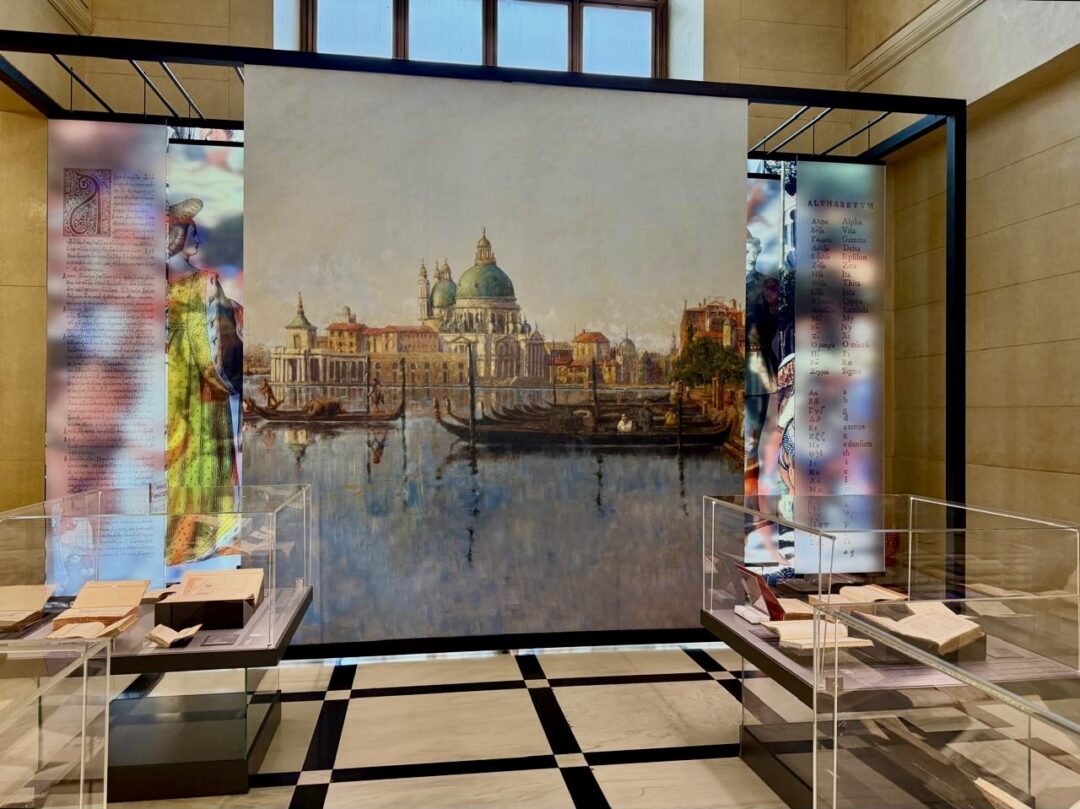
Byzantine scholars and Italian humanists. A cosmogonic encounter
At the turn of the 14th to the 15th century, Byzantine scholars, bearers of an uninterrupted literary tradition spanning centuries, encountered Italian humanists in a transformative intellectual collaboration. The Greek language became the key to accessing Homer, Plato, Aristotle, and the Church Fathers; it emerged as a vehicle for education, rhetoric, political and scientific thought, as well as theological reflection.
During the Middle Ages in the West, Greek as a spoken language survived only in certain Byzantine or formerly Byzantine regions of Southern Italy and Sicily. Although references to Greek learning up to the fourteenth century are sparse, from the ninth century on ward a limited but gradual awakening of interest can be observed, manifested in Latin translations of works by Aristotle, Galen, and the Church Fathers. From the thirteenth century, engagement with Greek texts became more systematic, while a pivotal development was the decision of the Council of Vienne (1311-1312) to introduce the teaching of Greek -aimed at the study of Christian literature- at the universities of Rome, Paris, Bologna, Oxford, and Salamanca. This was also the period when pioneering figures of humanism, such as Petrarch and Boccaccio, expressed an ardent desire to read Homer in the original. In order to learn Greek, some sought out scholars of Byzantine origin living in the West, while others traveled eastward, to Byzantium and to Venetian-ruled Crete, to study the language at its source, as did Guarino Veronese, who followed his teacher Manuel Chrysoloras to Constantinople.
On the occasion of the Council of Ferrara-Florence (1438-39), the last attempt at the union of the Churches, Byzantine scholars arrived in Italy and contributed decisively to the intellectual osmosis between East and West. Central figures included Georgios Gemistos Plethon, who helped rekindle interest in Platonic philosophy, and the bishop of Nicaea -later cardinal- Bessarion, who assembled an exceptionally rich collection of 752 manuscripts of classical texts, which he then donated to Venetian Senate. In the shadow of the Ottoman advance, and especially after the Fall of Constantinople, many Byzantine scholars migrated to the West. Settling primarily in the cities of Northern Italy, they taught their native language, copied manuscripts, founded schools, com posed linguistic manuals, and edited the first printed editions of Greek works. Through the Greek language, Renaissance Europe was thus provided with the means to reconnect with its own intellectual roots.
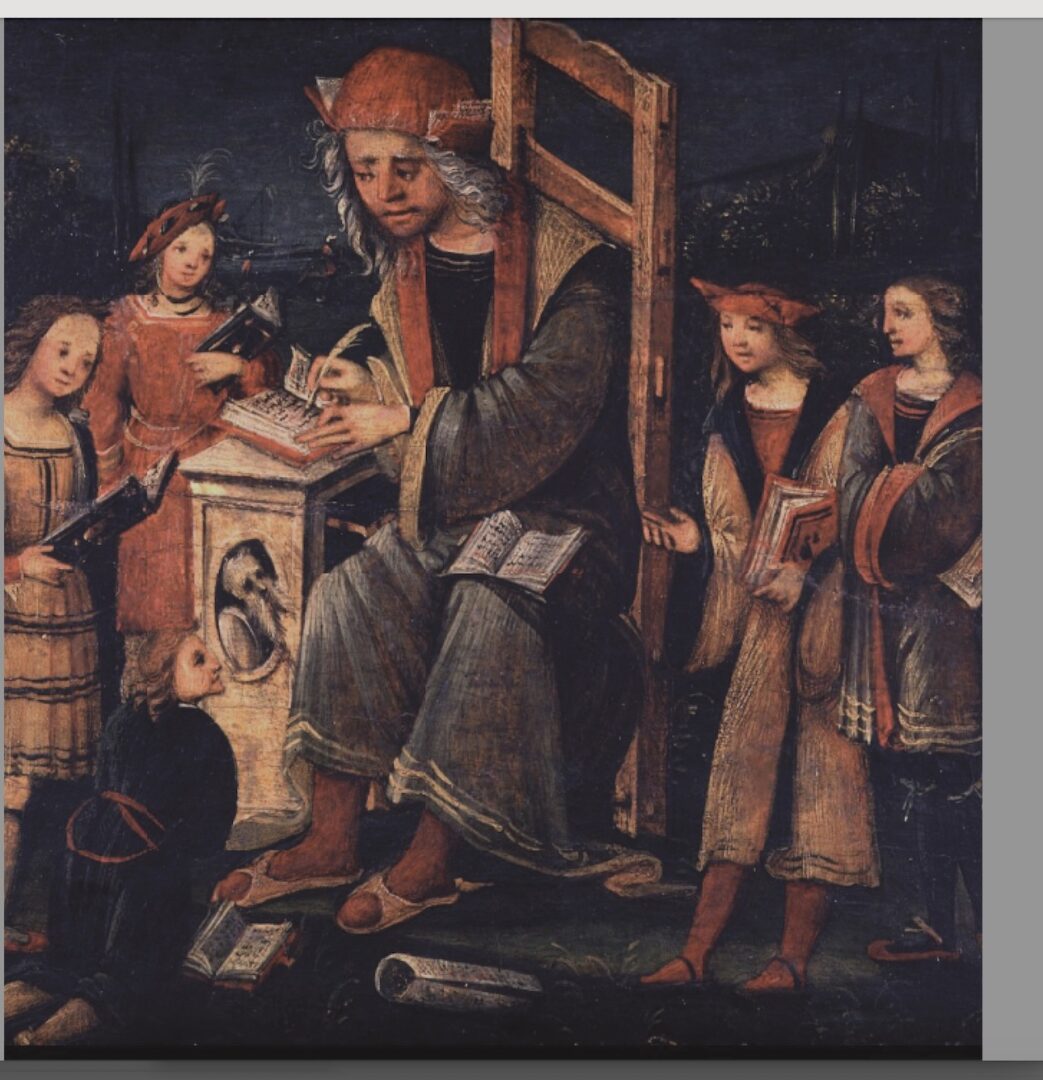
Manuel Chrysoloras. The first teacher
A leading representative of Byzantine erudition and diplomatic envoy of Emperor Manuel II Palaiologos to the West in search of assistance against the Ottomans, Manuel Chrysoloras (c.1350-1415) inaugurated the teaching Greek letters in Italy -and more broadly in Western Europe- in 1397. At the invitation of the Chancellor of the Florentine Republic, Coluccio Salutati, he taught for three years grammaticam et litteras grecas at the city’sStudium. His success rested on his clear and accessible method of teaching the demanding Greek language, as well as on his advocacy of sense-for-sense rather than word-for-word translation. Around him he gathered enthusiastic students, Italian humanists, and representatives of the ruling circles, among whom he ignited both the desire to approach texts in the original through the study of Greek, and an interest in the collection, systematic study, and translation of Greek works into Latin.
Aldus’s printing house
From the late fifteenth century onward, Italy (Florence, Milan, Venice, Padua, Rome) became the principal centre of Greek learning in Europe. Leading scholars taught there, among them Manuel Chrysoloras, Ioannis Argyropoulos, Demetrios Chalkokondyles, Janus and Constantine Lascaris, Marcus Musurus, and others. With the advent of printing in Venice and the typographical achievement of Aldus Manutius, Greek books were disseminated on an unprecedented scale, laying the foundations for humanistic studies and modern European education. Aldus Manutius (c. 1450-1515) was the first Renaissance printer to devote himself systematically -and at considerable personal financial risk- to the publication of Greek texts. With the establishment of his press in Venice and drawing primarily on manuscripts gathered by humanists across Europe, as well as the manuscript collection of his close collaborator, the Cretan scholar Marcus Musurus, he produced, from 1494 until his death in 1515, reliable editions of works of ancient Greek literature (Homer, Aristotle, Plato, Herodotus, Thucydides, Xenophon, Sophocles, Euripides, Aristophanes, among others). Seeking moreover to support the teaching of the Greek language, he published pedagogical works such as grammars and lexica (by Manuel Chrysoloras, Constantine Lascaris, Theodorus Gaza, Giovanni Crastone, and others), and he himself com posed a grammar, being an accomplished Hellenist and a meticulous philologist.
From Italy to the rest of Europe
In Western Europe, the spread of Protestantism further encouraged the study of Greek as an essential tool for direct access to the original text of the Holy Scriptures and the writings of the Church Fathers. At the same time, autonomous traditions of Greek learning developed in various regions (Germany, France, Switzerland, the Netherlands) even without the direct presence of first-generation Byzantine teachers.
The Greek language occupies a special position within European education, as it is experienced both as a medium for understanding the roots of European civilization and as the living language of a modern nation that carries a long-standing intellectual tradition. Italy remains one of the few European countries in which secondary-school students are systematically taught Ancient Greek language and literature, as a legacy of the historical emphasis on classical education that originated in the Renaissance and has continued to the present day. Chairs of Modern Greek Studies in Italy, the Hellenic Institute of Byzantine and Post-Byzantine Studies in Venice, as well as the presence of historic Greek communities in Southern Italy, have kept the intellectual relationship between the two countries alive and have encouraged, alongside the study of ancient literature, the exploration of Byzantine and modern Greek literature, history, and culture.
A similar situation can be observed in other European countries, such as France, Germany, Austria, the United Kingdom, Spain, Benelux, the Balkan and the Scandinavian states, as well as around the world, where universities and research institutes offer structured programs in Classical and Modern Greek studies or courses in Modern Greek, often in collabo ration with cultural institutions and Greek communities.
The vernaculars in the foreground
However, Greek letters in the West were not confined to the world of classical authors. Dictionaries, grammars, and multilingual manuals documented the living vernaculars -the language of merchants, sailors, diplomats, and travelers-, highlighting the continuity, adaptability, and dynamism of Greek across the centuries. These were essential both for the education of Greek communities in Western and Central Europe, and for the practical communication needs of everyday users of the language in the Eastern Mediterranean and in the territories of the Ottoman Empire. This development forms part of the broader emergence of the vernaculars as languages of literacy in Europe, a process that began in the thirteenth century, accelerated during the fifteenth, and became institutionally established in the sixteenth.
Both ancient and vernacular Greek have been, and continue to be, cornerstones of European intellectual identity- a language that is still read, taught, and continues to inspire today.
The exhibition was inaugurated by the President of the Parliament, Mr. Nikitas M. Kaklamanis on February 9th 2026, on the occasion of the International Greek Language Day established by UNESCO. It will run until the end of June 2026.
The Hellenic Parliament offers guided tours for the public.
👉 Information and tour bookings here
EXHIBITION CONTRIBUTORS
GENERAL CURATION Dr Maria Kamilaki
Αcting Director General, D.G. of Electronic Administration, Library & Publications
SCIENTIFIC CURATION Dr Maria Vlassopoulou
Head of the Benakeios Library & Political Figures Department, Hellenic Parliament Library
ORGANIZATION-CURATION Sophia Hiniadou Cambanis
Attorney at Law-Cultural Management Advisor, D.G. of Electronic Administration, Library & Publications
RESEARCH-TEXTS-ANNOTATIONS
Dr Maria Vlassopoulou
Natassa Papakonstantinou
Philologist, D.G. of Electronic Administration, Library & Publications
SCIENTIFIC ADVISORS
Agamemnon Tselikas
Philologist-Paleographer, Honorary PhD, Democritus University of Thrace
Dr Ioannis Kassidis
Philologist-Byzantinist, D.G. of Electronic Administration, Library & Publications
EXHIBITION DESIGN
Maria Papadopoulou
Architect-Set & Costume Designer, Hellenic Parliament Library
GRAPHIC DESIGN OF DISPLAY MATERIAL – PRODUCTION OF AUDIOVISUAL & DIGITAL APPLICATIONS
Thymios Presvytis – PEAK DESIGN This exhibition was based on the creative and curatorial concept of the first edition (2023) ALPHA BETA. APRENDERE IL GRECO IN ITALIA / LEARNING GREEK IN ITALY (1360-1860), Biblioteca Braidense, Milan, curated by Geri De la Rocca de Candal, Paolo Sachet, Marina Zetti.
Exhibition Highlights at a Glance
- Manuel Chrysoloras’ Erotemata (1475–1476): The first manual for teaching the Greek language in Renaissance Italy, marking the beginning of the systematic study of Greek in the West
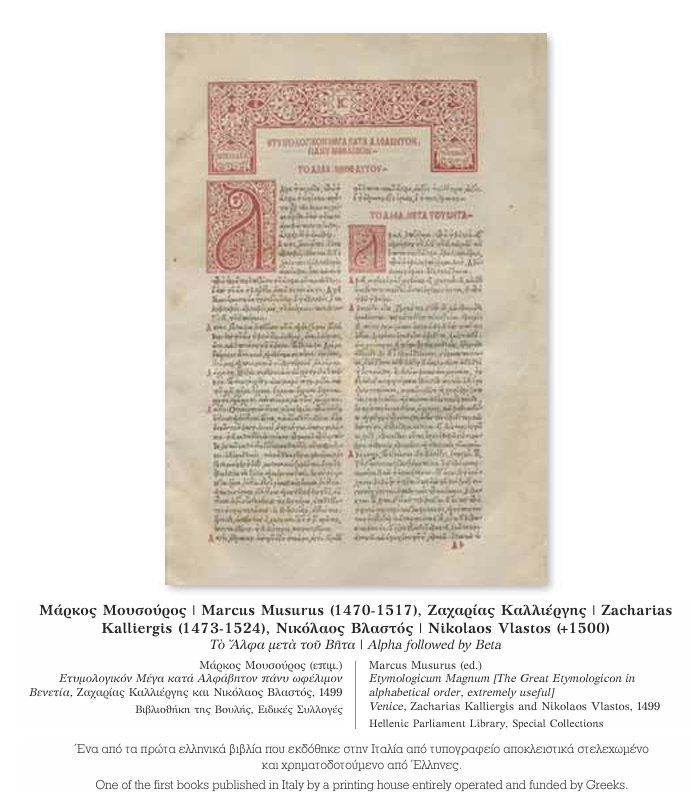
- Etymologicum Magnum (1499): The monumental edition by Z. Kalliergis, M. Musurus, and N. Vlastos; the starting point of independent Greek printing activity
- Incunabula and Early Editions from the Aldine Press: The first printed editions of classical literature: Aristotle (1497), Aristophanes (1498), Plato (1513)
- Corona Preciosa (1527): The first printed dictionary to feature the vernacular Greek language
- Henri Estienne, Thesaurus Graecae Linguae (1572–1573): The most significant lexicographical work of the Renaissance
- Nikolaos Loukanis, Homer’s Iliad (1640, 1st ed. 1526): The first verse translation of the Iliad into vernacular Greek, adorned with exceptional woodcuts
- Alessio da Somavera, Tesoro della lingua greca volgare ed italiana (1709): The Greek-Italian dictionary by the missionary Alessio da Somavera, featuring handwritten notes by Adamantios Korais
Browse Digitally
- The oldest incunabulum in the Library of the Hellenic Parliament: Manuel Chrysoloras’ Erotemata (1476)
- The first printed Greek Grammar, written entirely in Greek, by Constantine Lascaris (1476), from the collections of the National Library of Greece
- The autograph manuscript of Aldus Manutius’ Grammar (1515), from the treasures of the Biblioteca Ambrosiana in Milan