The Greek Pavilion at the 61st International Art Exhibition La Biennale di Venezia has officially opened to the international public with Escape Room, a large-scale installation by internationally acclaimed artist and architect Andreas Angelidakis. Curated by George Bekirakis and commissioned by the Metropolitan Organization of Museums of Visual Arts of Thessaloniki (MOMUS), the project was inaugurated on Thursday, May 7, 2026, and will remain on view through November 22, 2026.
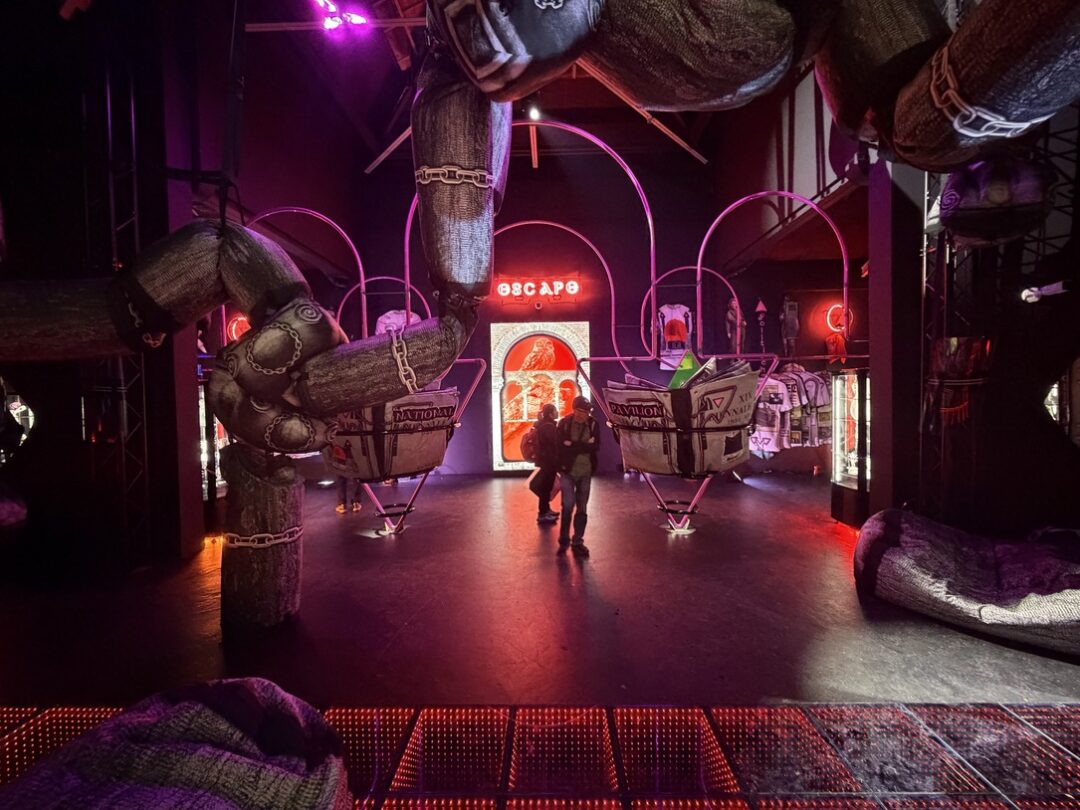
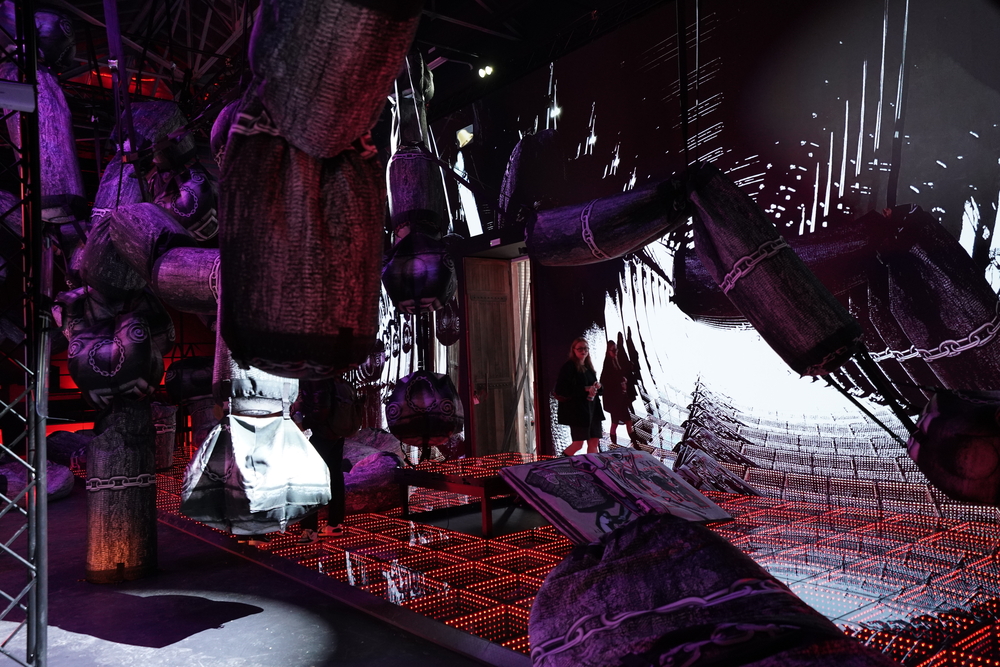
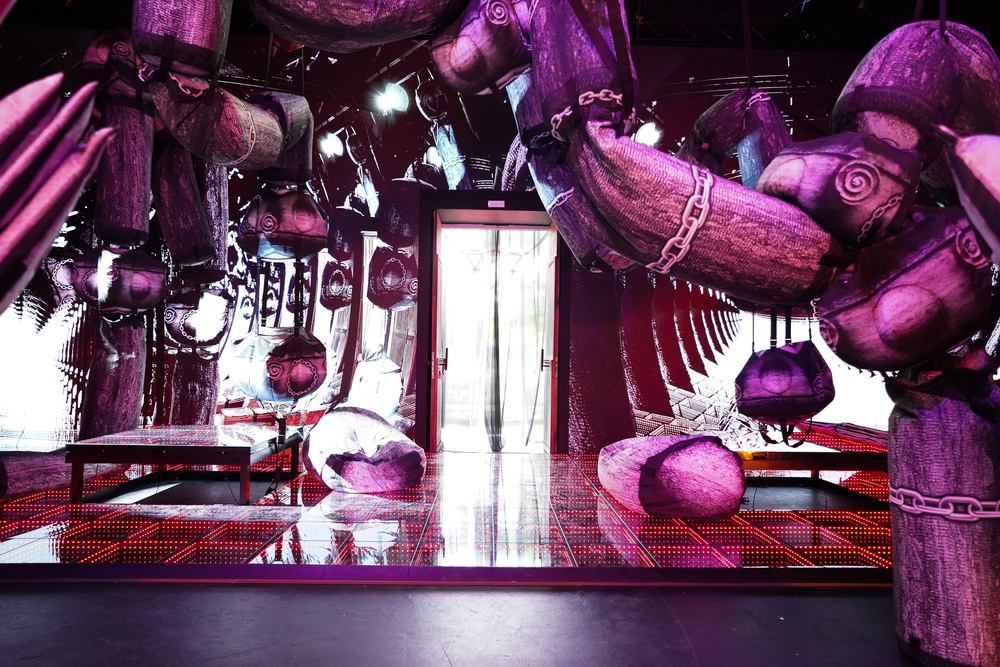
Transforming the Greek Pavilion into a present-day Platonic Cave, Andreas Angelidakis reimagines Plato’s seminal text as an immersive, inhabitable environment, situated within the current era of post-truth and rising nationalist populism. The Platonic allegory becomes a malleable instrument for probing the present, in which the world of images is saturated with digital illusions and cultural replicas. Shifting the focus to the history of the Greek Pavilion itself, the installation assembles elements presented as contested, constructed truths, illuminating both the complex nature of historical knowledge and its entanglement with nationalism and propaganda.
With a long-standing and distinguished presence on both the Greek and international art scenes, Athens-based Andreas Angelidakis has forged a hybrid, research-driven practice that brings architecture into vivid dialogue with the visual arts and digital media. His work touches upon the notions of ruin and historicity, articulated through narratives that resist linearity and challenge entrenched binaries such as the imaginary and the real, the physical and the virtual, the authentic and the copy. His installations approach history through the strategies of displacement, distortion, inversion, and humor, staging alternative frameworks for reading reality, identity, and cultural memory anew. Fiction lies at the core of his methodology as a primary narrative tool, while through processes of queering and the destabilization of the mechanisms that underpin truth and authenticity, his work probes the architecture of perception, culture in the making, and the construction of selfhood.
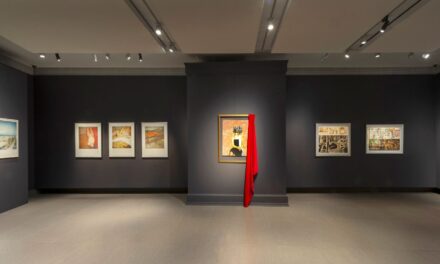
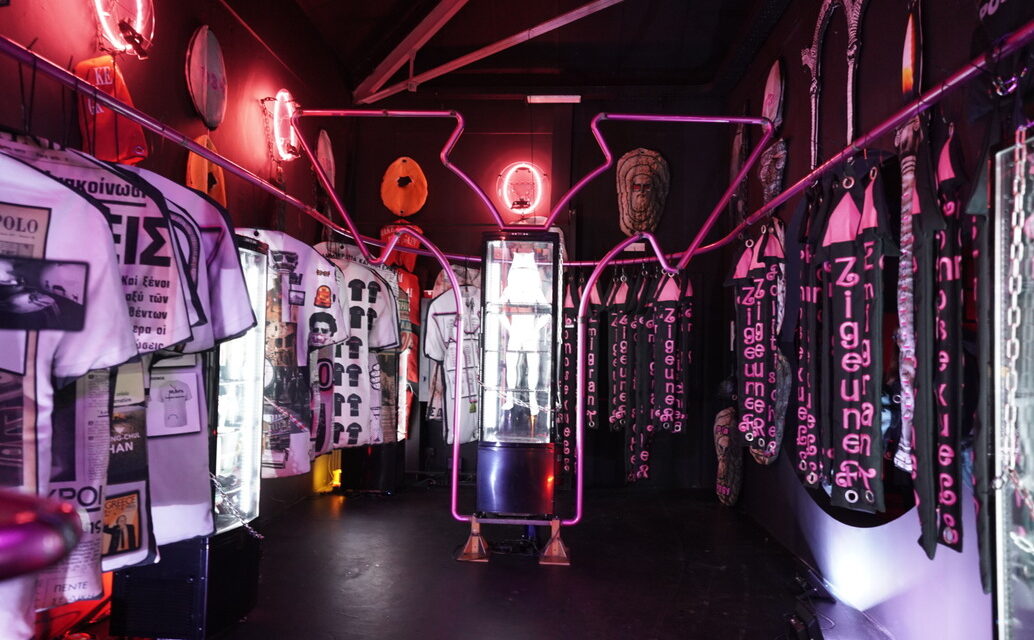
“The national pavilion is divided in two: the National and the Pavilion. Both function as mechanisms similar to those described by Plato in the Symposium,” Andreas Angelidakis explains. Transforming the pavilion into a labyrinth of images, objects, architectural fragments, videos, and “souvenirs” drawn from Greek history and identity, the artist creates a contemporary Platonic cave; a space where history, ideology, and national narratives are simultaneously produced, repeated, and dismantled.
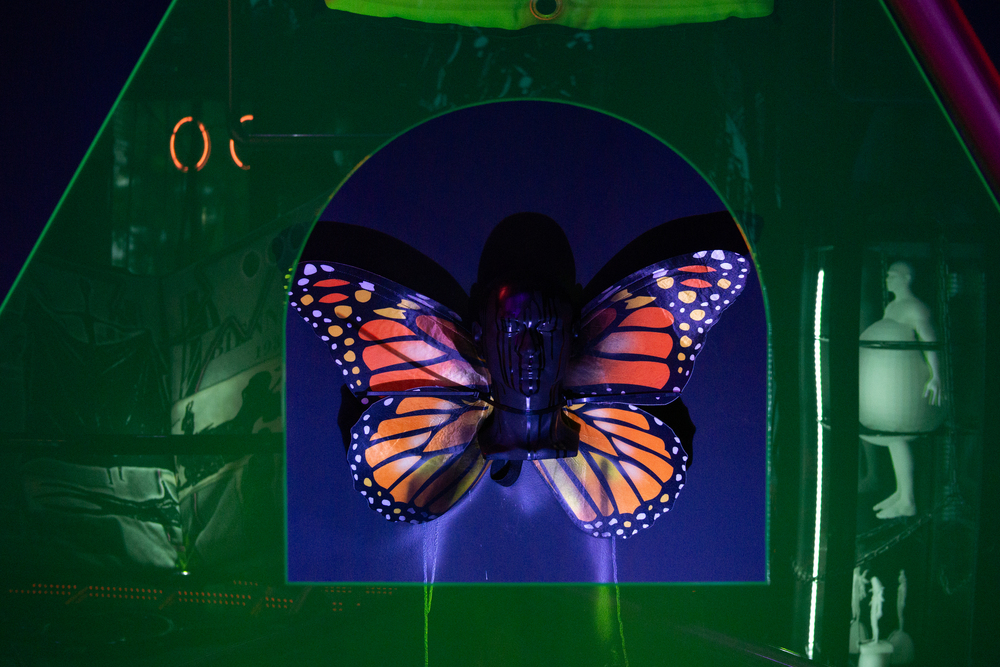
At the heart of the installation, an imprisoned surveillance camera continuously films itself. Scattered objects and references operate as fragmented lectures or traces of collective memory: the year of the Greek Civil War, when Greece did not participate in the Biennale and Peggy Guggenheim rented the Greek Pavilion to exhibit Cubist and Surrealist works then perceived as anti-fascist art; a small monument dedicated to Vasso Katraki at the pavilion entrance; and references to Yannis Tsarouchis, Zak Kostopoulos, and Maria Beikou.
Speaking at the opening, Deputy Minister of Culture for Contemporary Culture Iason Fotilas emphasized the collaborative effort behind the presentation:
“I will not speak about the artistic work itself, as others are far more qualified to do so. Besides, this project is so compelling and powerfully structured that it speaks for itself and speaks to everyone. What I would like to highlight instead is the invisible work behind the scenes; the extensive effort undertaken by our national commissioner, MOMUS. The interventions, the security systems, the infrastructure, and the overall preparation made it possible for this work to be presented in its complete form and without limitation. Successful organizational work is invisible: it allows the artwork and the artist to speak freely.
The Ministry of Culture, Minister Lina Mendoni, and I have always stood, and continue to stand, by the commissioner, the artist, and his team to present an important proposal that I am certain will spark meaningful dialogue. I would also like to thank the strategic supporter of the Greek participation, the Onassis Foundation, as well as all those who have supported Greece’s presence at the Biennale.”
The President of the Metropolitan Organisation of Museums of Visual Arts of Thessaloniki (MOMus), Epameinondas Christofilopoulos, stated:
“A few months ago, we undertook the role of national commissioner with enthusiasm and a great sense of responsibility. This assignment allowed us to serve a particularly ambitious endeavor and to contribute meaningfully to the national presence in Venice through Andreas Angelidakis’s Escape Room. With the unwavering support of the Ministry of Culture, we completed an extensive and demanding project in an exceptionally short period. Today, we stand before the result with the conviction that visitors to the Greek Pavilion will experience something truly meaningful.”
A special publication accompanying the installation includes a text by curator George Bekirakis, who describes Escape Room as an allegory of life under contemporary capitalism:
“Escape Room presents the viewer with an analogy of life under the shadow of capitalism. Traces are everywhere. The game we must escape from is not a room, but a deep, dark cave, shielded by the buzzing of millions of images circulating across our screens. Real and surreal realities collide on platforms that drain our attention while simultaneously serving national agendas and commercial interests. In this work, Andreas Angelidakis reverses spatial hierarchies, creating the paradox of a habitable ruin within the digital panopticon. Ultimately, he discreetly offers the audience clues that they may either sift through or simply overlook. Essentially, the viewer is invited to decide how to exercise their capacity to act and where to direct their attention. After all, it is just a game.”
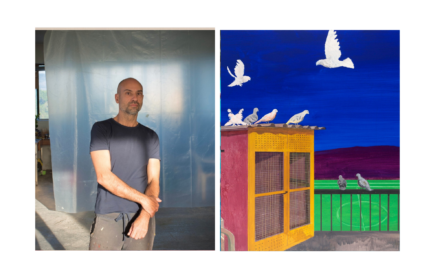
Andreas Angelidakis (b. 1968, Athens) is an architect and artist based in Athens. He studied architecture at the Southern California Institute of Architecture in Los Angeles and subsequently at Columbia University in New York. His artistic practice is informed by a vibrant interdisciplinary engagement spanning architecture, publications, writing, design, and exhibition-making. His work materialises at the threshold between the real and the virtual, historical memory and fiction, sincerity and humour, constructing new narrative environments that propose new modes of experiencing and inhabiting the contemporary cultural and digital condition. In his conceptual cosmos, architecture operates more broadly as a vehicle for exploring identity, while Athens and the notion of the ruin – ancient, modern, or digital – recur as constant and critical motifs throughout his artistic output. From installation to essays, each work distils his ongoing inquiry into the relationship between viewer and artwork, foregrounding the interplay of power, space, and infrastructure through idiosyncratic visual systems that privilege embodied experiences within digital states.
As a testament to the international recognition of his work in architecture, art, and curating, Angelidakis has lectured widely at various universities and art institutions around the globe, and his work has been featured in leading international art publications and media, including Artforum, Frieze, e-flux, RIBA Journal, Nowness, Financial Times, Art Pulse, Archinect, Architectural Record, The New Yorker, Art in America, ArtReview, NERO Editions, La Repubblica, Flash Art, Dezeen, Designboom, Wallpaper, ARTnews, and The Art Newspaper, among others.
His work has been presented in Greece and internationally at prominent institutions and exhibitions, including: the National Museum of Contemporary Art Athens (ΕΜΣΤ), Athens; Onassis Foundation, Athens; documenta 14, Athens and Kassel; Museum of Contemporary Art, Chicago; Galeria Municipal do Porto; Espace Niemeyer, Paris; Hayward Gallery, London; ETH, Zurich; and the Louisiana Museum of Modern Art, Humlebæk. His works are held in prominent public and private collections worldwide.
“Escape Room” is funded by Hellenic Ministry of Culture. Onassis Culture is strategic supporter. Additional supporters include ΕΚΚΟΜΕΔ (Hellenic Centre for Audiovisual Media and Creation), Qualco Group, Qualco Foundation, the National Bank of Greece, Ioannis and Maya Martinou, and Ioanna Martinou. The work is also supported by the Organization for Culture and Development NEON, the Irene Y. Panagopoulos Collection, the Office for Contemporary Art Norway (OCA), Anastasia Tsoureka-Sarakaki, Perianth Hotel, Aliki Martinou, Giorgos Petrocheilos and Diamantis Xilas, Eirini Laimou, the Thessaloniki Film Festival, the company “The Art of Living”, ARCH, Polygreen Culture & Art Initiative (PCAI), Eleni Martinou and Andreas Melas.
The official air transport sponsor is AEGEAN.
Photo Credits: Vladimiros Nikolouzos