The web portal Study in Greece is campaigning for the promotion and international visibility of Greek Universities and the comparative educational advantages of our country. In particular, the campaign focuses on the foreign language study programs that Greek Universities offer to Greek and international students. The initiative is supported by the General Secretariat of Higher Education of the Ministry of Education and Religious Affairs and the General Secretariat for Greeks Abroad and Public Diplomacy of the Ministry for Foreign Affairs. In this context, a number of educational programs and actions are presented in detail on a regular basis, such as undergraduate and postgraduate programs, summer schools etc, to inform international students about the many foreign language options offered by Greek Universities.
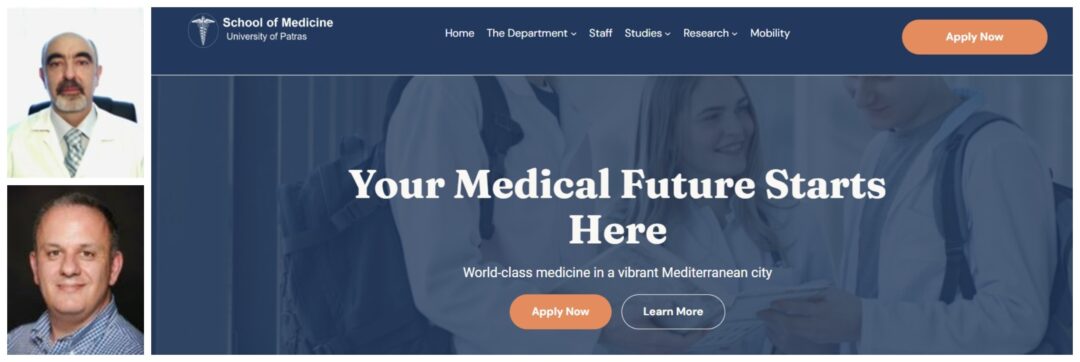
George L. Adonakis (upper left) is a Professor of Gynecology and Obstetrics and serves as Chair of the Faculty of Medicine at the University of Patras. George C. Kagadis (lower left) is a Professor of Medical Physics and Medical Informatics at the University of Patras, with expertise in biomedical imaging, data analysis, and healthcare technologies. He also serves as Director of the English-taught Medical Degree Program.
Study in Greece interviewed Professors George L. Adonakis and George C. Kagadis about the newly established English-taught medical degree at the University of Patras, focusing on its key features and the opportunities it offers to international students, including its modern curriculum, strong clinical training, global orientation, and support for students coming from abroad.
Please provide us with an overview of the new international Medical Degree of the University of Patras, its program structure and main research areas.
The English Medical Program (EMP) of the University of Patras is a six-year, 360-ECTS undergraduate medical degree delivered entirely in English, admitting fifty students per academic year. The curriculum is organized around three integrated modules: a preclinical foundation in the first two years, a clinical phase from the third through the fifth year, and a dedicated clinical practice module in the fifth and sixth years at the University General Hospital of Patras (PGNP) — one of the largest teaching hospitals in Greece — and at the University Health Centre. We have deliberately moved away from a purely lecture-based model, weaving in case-based discussions, small-group teaching, laboratory work, simulation-based clinical skills training from the very first semesters, and hybrid digital learning, so that each topic is taught by the most specialized faculty member and in the format best suited to it.
The School of Medicine’s research strengths — which directly inform the teaching — span molecular biology and genetics, neurosciences, oncology, cardiovascular and pulmonary medicine, medical physics and biomedical imaging, public health, and translational clinical research, supported by fully equipped laboratories, core research infrastructures, and a broad network of international collaborations. A defining feature of the EMP is that during the first six semesters students also follow Greek-language courses, so that by the time they enter intensive clinical rotations they can communicate meaningfully with patients and colleagues. Tuition is €12,000 per year, and few merit- and need-based scholarships are awarded annually.
How does the establishment of the program align with the University of Patras strategy for internationalization and extroversion?
The EMP is a concrete expression of a strategy the University of Patras has been advancing for some years now — moving from being a distinguished national institution to being a genuinely international one. An English-taught medical degree is, frankly, one of the most demanding undertakings a university can launch: it requires mature research infrastructure, a critical mass of English-proficient faculty, a major university hospital, and the administrative capacity to support international students end-to-end. The fact that the University of Patras can deliver all of this is, in itself, a statement about where the institution stands today. Beyond the program itself, the EMP deepens our collaborations with international academic centres, attracts faculty and researchers from abroad, and — importantly — brings to our campus a diverse student community that enriches the experience of every student at Patras, Greek and international alike.
Your program is the first international program of the University of Patras to begin at an undergraduate level. Would you say that it is only the first of many?
I would say so, yes — and I think that is the right ambition for the University. Launching an undergraduate program in English, particularly one as demanding as medicine, builds institutional capability that extends well beyond a single department: standardised international admissions, student support for non-EU applicants, academic advising in English, quality assurance aligned with international expectations. Once that infrastructure exists, other schools can build on it far more readily than if each were starting from zero. Medicine is a natural first step because of the sustained international demand for high-quality, English-taught medical education in Europe, but I fully expect the University of Patras to offer further English-taught undergraduate programs in the years ahead.

What kind of student life should applicants expect in your program?
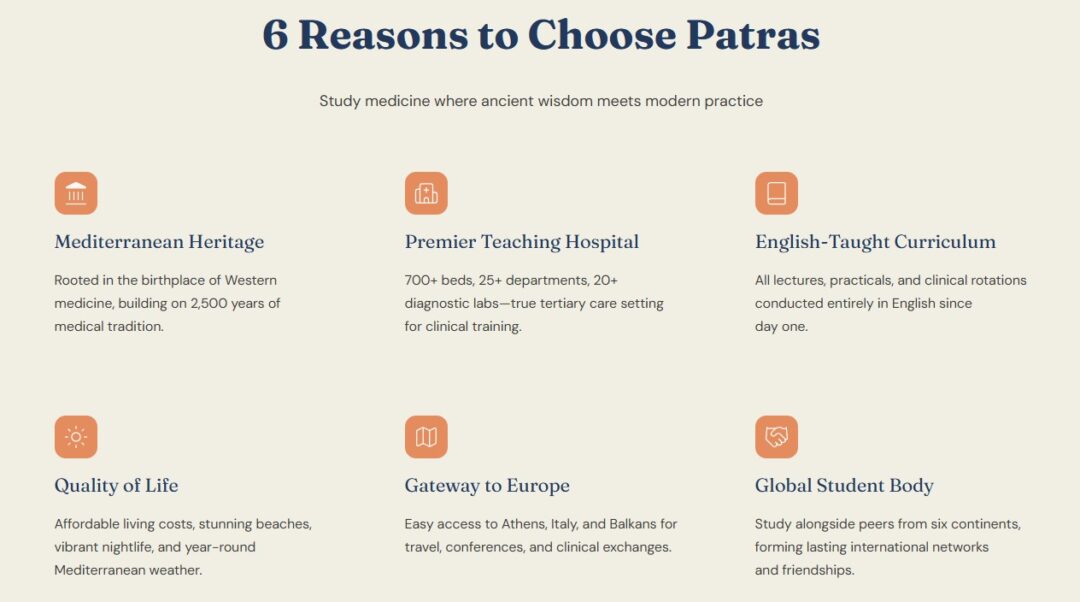
Patras is one of the friendliest student cities in Greece — a coastal city of roughly 200,000 people, large enough to feel cosmopolitan and small enough that students quickly feel at home. Our campus sits on the Gulf of Patras with views across to the mountains of mainland Greece, and students move easily between lecture halls, laboratories, the university hospital, cafés, and the sea. The EMP admits fifty students a year from around the world, which creates a close-knit, multicultural cohort in which friendships form quickly and cross every border.
Beyond the classroom, students have access to the full range of University of Patras facilities — libraries, sports and athletic clubs, cultural societies, and student associations — and to the Erasmus+ mobility network for exchanges across Europe and beyond. Because we teach Greek during the first three years, our international students integrate into local life in a way that is genuinely unusual for English-taught programs: they can chat with the baker, understand the news, travel independently around the country. Greece itself is, of course, part of the experience — the history, the islands, the food, and a pace of life that students tell us they come to love.
Could you say a few words on clinical training provisions for students in your program?
Clinical training is the heart of this program, and we have structured it deliberately. From the very first semesters, students acquire essential clinical skills in a simulation environment under the supervision of clinical faculty — so that by the time they step onto a ward, the fundamentals of patient examination, communication, and basic procedures are already familiar. From the third year onwards, clinical teaching is integrated: foundational science is taught alongside the corresponding clinical discipline, so students build basic and clinical knowledge in parallel rather than in sequence. Every student maintains a clinical logbook documenting the competencies they must demonstrate, and completion of that logbook is a prerequisite for final clinical examinations.
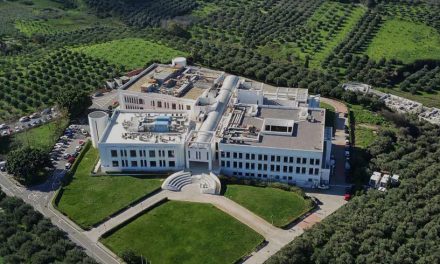
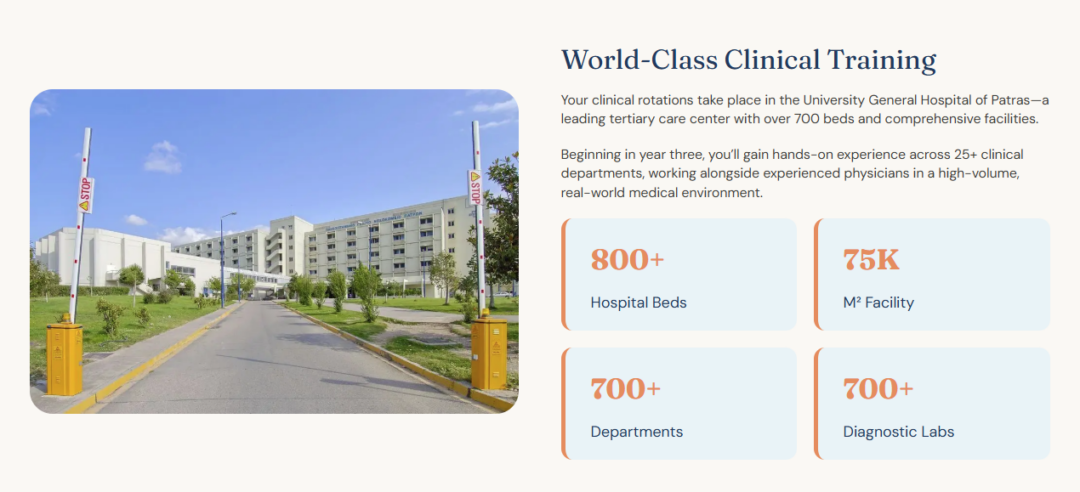
The bulk of clinical training takes place at the University General Hospital of Patras, a major tertiary referral center covering the full range of medical and surgical specialties, complemented by the University Health Centre for primary care exposure. The fifth and sixth years are devoted entirely to clinical practice — effectively two full years of supervised, hands-on rotations — which is where students consolidate everything they have learned and step into the role of a junior doctor in training.
What degree of recognition will students have upon graduation and what kind of gateways for residencies or specializations should be expected?
Graduates of the EMP receive the Medical Degree of the University of Patras — the same degree awarded to graduates of our Greek-language program, with no distinction whatsoever on the diploma. Because the degree is issued by a Greek public university accredited by the Hellenic Authority for Higher Education, it is automatically recognized across the European Union under the EU’s Directive on the mutual recognition of professional qualifications (2005/36/EC), meaning graduates can pursue residency training and medical practice in any EU/EEA member state after fulfilling local registration requirements.
Beyond the EU, our graduates will be well positioned to sit the licensing examinations that open most major medical systems — the USMLE in the United States, the PLAB/UKMLA in the United Kingdom, the MCCQE in Canada, and equivalent pathways in Australia, the Gulf, and elsewhere. Our curriculum is deliberately benchmarked against international standards so that students are prepared for these examinations as a natural extension of their studies, not as a separate undertaking. Within Greece, graduates can enter the national residency system across the full range of specialties. In short: a degree from the EMP is a globally portable qualification, and a graduate’s choice of where to specialize is just that — a choice.
Applications are now open! For more, follow the link:
TAGS: MEDICINE | PATRAS | STUDY IN GREECE | UNIVERSITY OF PATRAS