Academy of Athens: Meeting on the Voyager Missions – “A Day of Light”
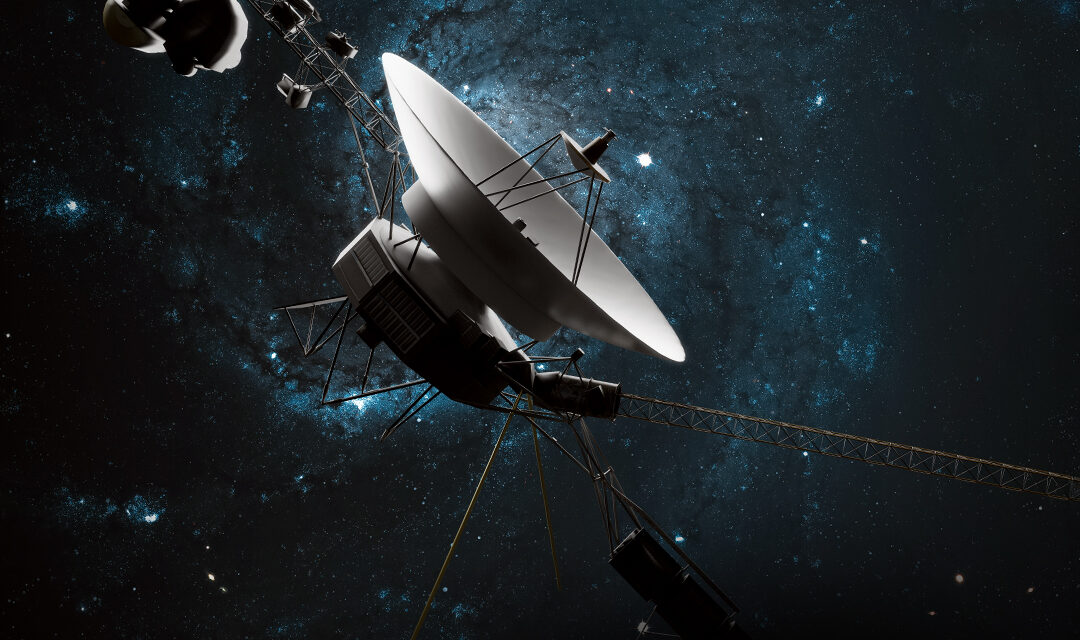
The Voyager missions, led by National Aeronautics and Space Administration (NASA), the United States space agency, have been exploring space for the past 49 years.
On November 18, 2026, at 5:16:07 a.m. Eastern Time (ET), Voyager 1 will reach a distance of approximately 26 billion kilometers from Earth, at which point the time required for a communication signal to travel between the spacecraft and Earth will be exactly 24 hours – or “one day of light.”
In 2027, the Voyager missions will celebrate 50 years of travelling through space, an extraordinary journey that continues to inspire emotion, enthusiasm and wonder. This remarkable milestone coincides with the centenary celebrations of the Academy of Athens.
Greece is actively participating in this historic space mission through the Center for Space Research and Technology of the Academy of Athens.
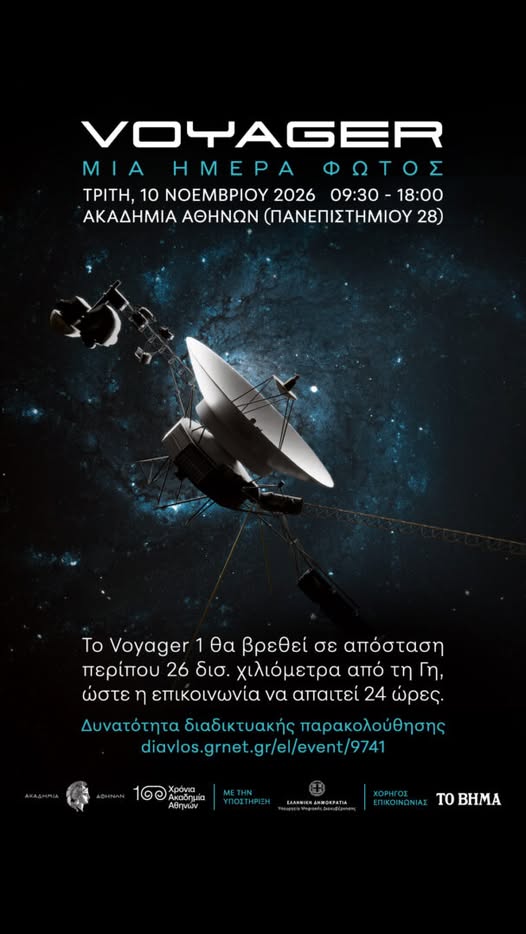
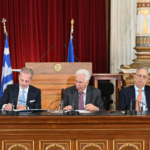
The Space Research and Technology Centre, together with Stamatios M. Krimigis, former President of the Academy of Athens, organized a special event on the Voyager missions entitled “A Day of Light” on November 10, 2026, at the Academy’s premises. The event brought together distinguished NASA scientists who have dedicated part of their careers to this mission.
As the distinguished Greek scientist and pioneering figure of the Voyager mission, Stamatios M. Krimigis, told the Athens-Macedonian News Agency (AMNA):
“Voyager is the human-made object that is farthest from Earth and represents our message to the Galaxy. It also carries the Golden Record, which contains information about what humanity is and where we come from.”
“In my view, the greatest achievement of the Voyager missions is that they crossed the boundaries of our Solar System for the first time and entered interstellar space. Such an achievement will not be repeated for many years to come,” he emphasized.
In 1971, Mr Krimigis was the youngest scientist to join the Voyager mission’s scientific team. At the time, the programme was known as “Mariner Jupiter Saturn 1977” and was renamed “Voyager” shortly before the launch of the two spacecraft.
“Being part of this team is very moving,” he said.
Today, he is the only surviving member of the original team. He recalls that the mission was initially expected to last just four years.
“We never imagined it would last this long,” he said, adding: “We fought real battles.”
He was referring, in particular, to the efforts made to secure the funding required for the programme, which would allow the spacecraft to explore the outer planets of the Solar System and subsequently continue their journey into interstellar space.
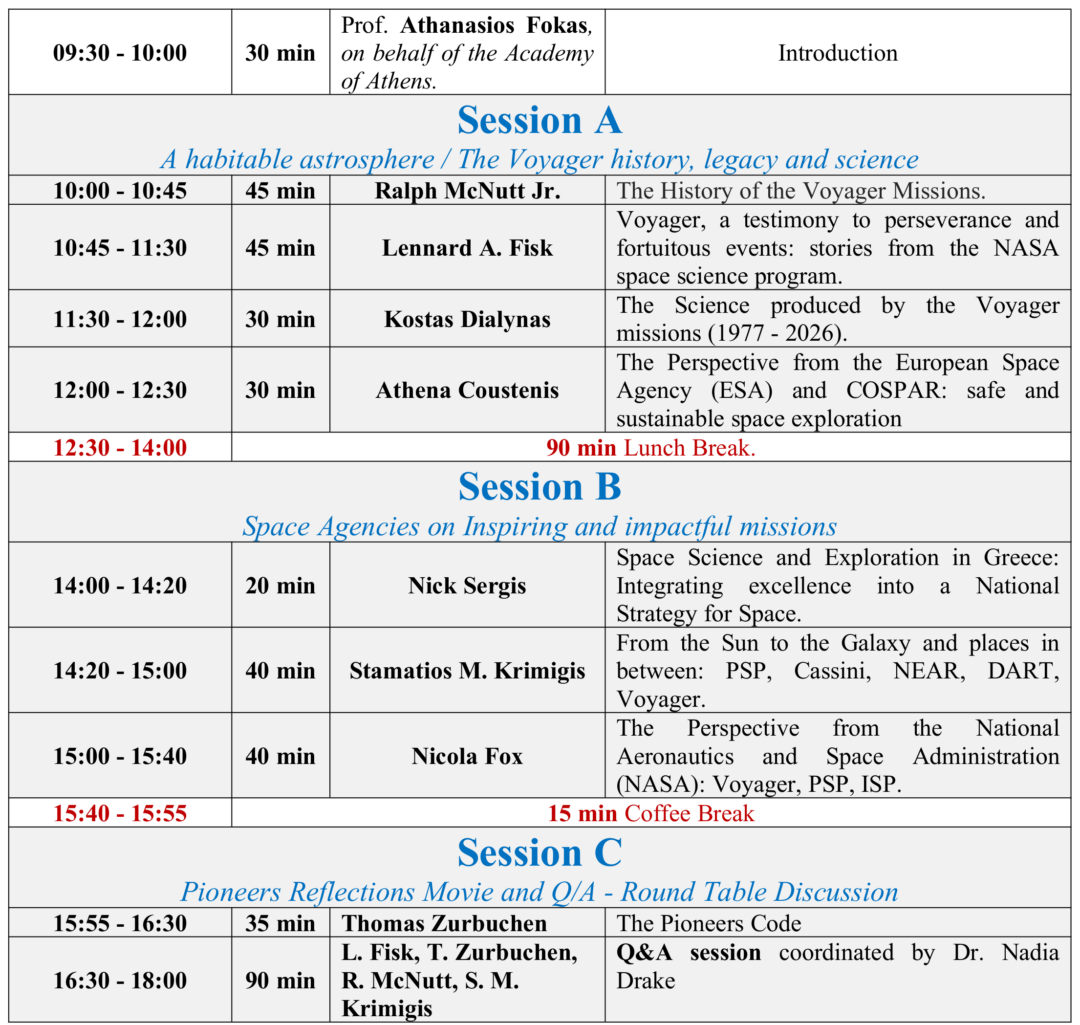
Lennard A. Fisk, Professor at the University of Michigan and former Associate Administrator for Space Science and Applications at NASA, spoke about “certain fortunate and unexpected events that proved beneficial” to the continuation of the Voyager mission.
He specifically recalled that in 1989, when Voyager 2 completed its exploration of the four giant planets of the Solar System with its arrival at Neptune, “the Voyager programme no longer had a place within the Planetary Science Division. In order for it to continue, it had to be transferred to another, more appropriate division.”
At the time, he was responsible for planning all of NASA’s space science programmes. He transferred the administrative responsibility and funding for Voyager to the Solar and Space Physics Division, which he himself had re-established.
Reviewing the achievements of the Voyager spacecraft, Ralph MacNutt Jr., Head of Space Science at the Johns Hopkins University Applied Physics Laboratory and a long-standing member of the mission’s scientific team, highlighted several major discoveries.
These included the only close-up explorations ever conducted of the Uranian and Neptunian systems; the discovery of rings around Jupiter, Uranus and Neptune; and the identification of spokes within Saturn’s rings.
The missions also revealed the presence of sulphur and volcanoes on Io, one of Jupiter’s moons, as well as ice geysers and volcanic activity on Triton, Neptune’s moon. Furthermore, they discovered magnetic fields, magnetospheres and radiation belts around Uranus and Neptune.
“Finally, we observed the boundaries of the heliosphere,” he added.
According to Kostas Dialynas, Director of the Space Research and Technology Centre of the Academy of Athens, one of the mission’s greatest achievements was the fact that the Voyager spacecraft crossed the heliopause – the outer boundary of the heliosphere – and entered interstellar space.
However, the precise location of the heliopause remains a subject of scientific debate and disagreement. Some scientists, including Lennard A. Fisk, believe that the two spacecraft have not actually crossed this boundary.
“We have not yet managed to resolve this controversy, and several questions remain open for discussion. That is what science is all about: we ask questions, we discuss them, and we do not always agree,” Mr Dialynas added.
To provide a visual summary of the discoveries made by the Voyager missions, Mr Dialynas presented a blurred and dark representation of the heliosphere, about which we still have questions and whose answers remain unknown.
What the Voyager missions have achieved, he explained, is precisely to make this picture clearer.
The Voyager spacecraft are running out of power
Speaking via video conference, Nicola Fox, NASA’s Associate Administrator for the Science Mission Directorate, described as a “miracle” the ability of older-generation technology to withstand such extreme environments for such a long period.
“The mission was designed approximately 60 years ago, and next year it will be 50 years since the spacecraft were sent into space. Yet both are still operating in interstellar space. This is old technology, but just think about its quality: it is still working today,” she explained.
She also praised the creativity of the Voyager team.
“Do you remember what they called the ‘Big Bang’? It was the moment when they performed a system reboot, finding a way to extend the spacecraft’s operational life even further. It is truly extraordinary and deserves our admiration,” she said.
However, the energy reserves of both spacecraft are now running low, and their operations are not expected to continue for much longer.
Ms Fox emphasized that the Voyager mission is, in a sense, “laying the groundwork for the scientific questions and planning behind ‘Interstellar Probe’, the next mission we hope to send into interstellar space.”
When asked how long it might take for a future mission to reach interstellar space, she replied:
“I think the fastest scenario envisages a journey of approximately 30 to 35 years before reaching that destination. Voyager 1 entered interstellar space in 2012 and Voyager 2 in 2018, so it took them more than 30 years to get there. We now have new technologies and can certainly accelerate the process, but the distance we need to travel to reach interstellar space remains immense.”
Thomas Zurbuchen, Professor at ETH Zurich, who preceded Nicola Fox in this position and held the role longer than anyone else, overseeing major space missions, including the James Webb Space Telescope, made the following observation:
“The vast majority of missions are not pioneering endeavors on the scale of Voyager. Almost everything about the Voyager programme was unprecedented: its duration, the types of technologies employed and the diversity of their applications.
“It was something entirely new, a truly pioneering undertaking. Everything we are working on today has its origins in Voyager.”
The meeting can be watched online on demand through the following link:
Watch the Voyager meeting – “A Day of Light”
A few words about the Center for Space Research and Technology
The Space Research and Technology Centre of the Academy of Athens was established in 2023, replacing the Office of Space Research and Technology, which had been created in February 2006.
Its establishment followed the election, in November 2004, of Professor Stamatios M. Krimigis as a full member of the Academy of Athens, occupying the academic chair of “Space Science – Theory and Applications”.
Since 2006, the Space Research and Technology Centre has participated in leading international collaborations in the fields of space research and technology, sometimes taking a leading role as Principal Investigator (PI) or Co-Investigator (Co-I).
Through these activities, the Centre makes an important contribution to a wide range of cutting-edge scientific and technological projects, including the following major space missions:
- Voyager 1 and Voyager 2 (NASA)
- Cassini-Huygens (NASA/ESA)
- MESSENGER (NASA)
- Parker Solar Probe (NASA)
- JUpiter ICy moons Explorer (JUICE) (ESA)
- New Horizons (NASA)
These collaborations place the Academy of Athens and Greece at the forefront of important international scientific and technological developments in space exploration.