
Bringing together key stakeholders from across the public and private sectors, the 2nd Annual Athens AI Summit 2026 put the spotlight on how Artificial Intelligence is moving from strategic ambition to real-world implementation. Held in Athens on Wednesday, 11 November, 2026 under the theme “AI: From Strategy to Operational Deployment”, the Summit explored the latest developments, practical applications and future prospects of AI.
The Conference was organized by METATEAM, in collaboration with AI Report magazine, under the auspices and with the support of, among others, the Ministry of Digital Governance and Artificial Intelligence and the National Documentation Centre (EKT).
The Conference focused on one of the most important challenges facing the Greek economy and public administration: the transition of Artificial Intelligence from strategic planning and technological experimentation to practical, real-world deployment. It highlighted that the challenge is no longer simply about adopting new applications, but about integrating AI into business and administrative processes, influencing investment decisions and generating measurable value.
This development marks a fundamental shift. Businesses are being called upon to redesign their operations, leverage data and new computing infrastructure, and align their investments in AI with productivity and competitiveness objectives. Similarly, the public sector faces the challenge of moving beyond the digitalization of services towards the substantive transformation of its operating model.
Drawing on the key themes and discussions at the Athens AI Summit, alongside developments highlighted by ICTPLUS.GR, a specialist publication covering the Information Technology and Telecommunications sectors, ten key conclusions emerge, offering an initial assessment of the next phase of AI adoption in Greece:
- AI is becoming a management and leadership issue, not merely a technology issue.
- Businesses and public organizations are moving from experimentation to operational deployment.
- Return on investment (ROI) is becoming the primary measure of success.
- AI agents are transforming the operating models of businesses and public organizations.
- Data, cloud infrastructure and computing power are acquiring strategic importance.
- AI governance and cybersecurity are essential prerequisites for implementation.
- The public sector must move from digital services towards intelligent operations.
- Open AI and technological sovereignty are becoming strategic priorities.
- Human capital is the decisive factor in successful AI adoption.
- Greece needs a coherent national strategy connecting infrastructure, research and commercial application.
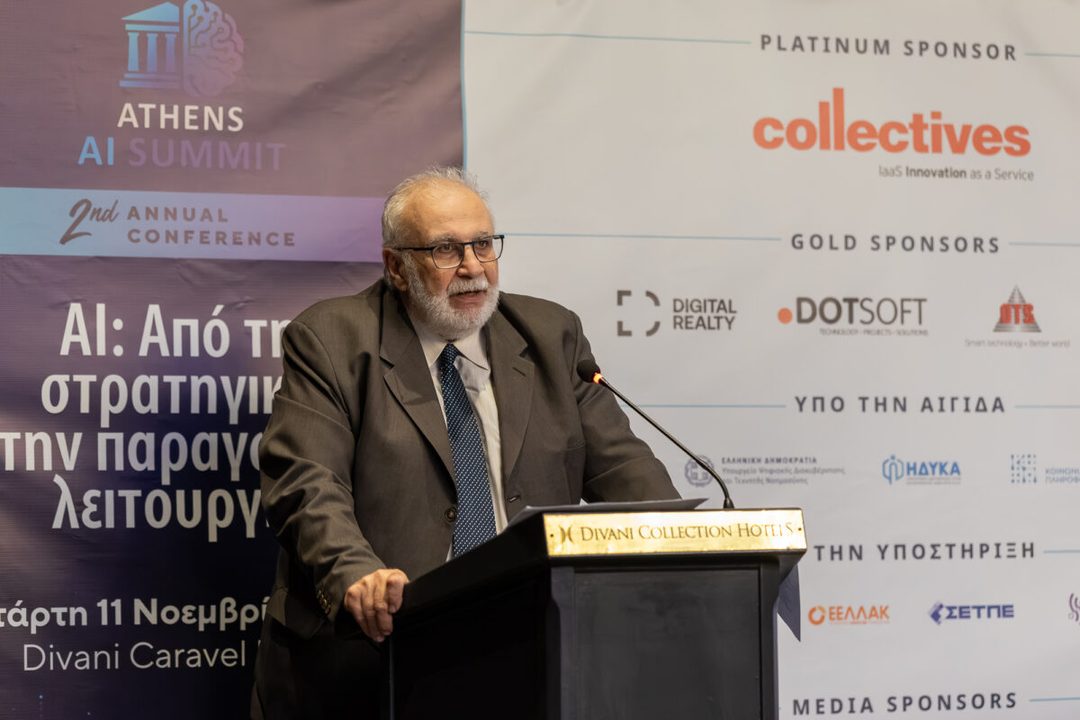
“AI Technologies and Infrastructure: Applications, Data and Digital Security”
How AI can be integrated safely while respecting fundamental rights was the central topic of the session entitled “AI Technologies and Infrastructure: Applications, Data and Digital Security”, held as part of the Athens AI Summit 2026.
A common thread running through the speakers’ contributions was that technological progress cannot be separated from the safeguards required to protect citizens. Data quality, algorithmic reliability, clear accountability and the ability to ensure meaningful human intervention were identified as essential prerequisites for the responsible deployment of Artificial Intelligence systems.
Despite approaching the subject from different perspectives, the speakers converged on the need to view AI as a field encompassing technological, legal, organisational and societal challenges. Data protection, system security, decision-making transparency and meaningful human oversight are not merely supplementary features; they are fundamental conditions for the trustworthy adoption and use of AI systems.
The Way Forward: From AI Strategy to Action
The overall picture emerging from the developments and discussions at the Summit is that Greece is entering a new phase of digital transformation, in which the priority is no longer simply acquiring technology, but fundamentally changing the way organizations operate.
Large enterprises have already begun investing, SMEs are increasing their use of AI applications, the public sector is exploring new areas of deployment, and the country’s technological infrastructure is expanding. However, translating these individual developments into a comprehensive, production-ready operating model remains the major challenge.
The next chapter of Artificial Intelligence will not be determined by who has access to the largest number of AI tools, but by who can integrate them most effectively into their operational and administrative processes.
For businesses, this means greater productivity and competitiveness. For the public sector, it means more effective services and administrative transformation. For Greece as a whole, it means connecting technological investment with the real economy and developing domestic expertise and know-how.

AI at Work: Reshaping Government, Business and Employment
The transition of Artificial Intelligence from pilot projects to everyday operations across the public sector and businesses, the automation of administrative processes, the new opportunities emerging for citizens, and the impact on employment were among the key topics addressed at the 2nd annual Athens AI Summit 2026.
The contributions of Pavlos Kitsanelis, Public Sector Director for Greece, Cyprus, Malta and the Adriatic at Microsoft; Dr. Kyriakos Tolias, Director of the National Documentation Centre (EKT); and Stathis Hatziefthymiades, Vice-Chair of the Advisory Committee of GRNET (EDYTE) and Professor at the National and Kapodistrian University of Athens (NKUA), were of particular interest. The discussion was moderated by Giannis Chalavazis, CEO of META•TEAM.
The discussion highlighted that the next phase of digital transformation is not simply about introducing AI tools into existing processes, but rather about fundamentally redesigning them. The objective is to enable tasks that currently require multiple, sequential actions by citizens and public servants to be completed automatically, while retaining meaningful human oversight and control.
Open AI in Practice: From Pilot Projects to Production in Government and Business
Artificial Intelligence is now a driving force behind digital transformation. The key question, however, is no longer simply what AI can do, but how it can be put to work in practice – safely, transparently and interoperably, while delivering measurable results.
For both the public sector and businesses, the challenge lies in moving beyond isolated experiments and pilot projects towards fully operational AI solutions that address real-world needs and create tangible value.
Against this backdrop, open technologies, access to knowledge, digital sovereignty and closer cooperation between the public and private sectors are assuming growing importance. These themes were central to the presentations and discussions during the second thematic session of the 2nd Athens AI Summit, where speakers explored the practical steps needed to turn AI’s potential into meaningful impact.
From AI Strategy to Measurable Results: Turning Investment into Business Performance
Artificial Intelligence is entering a new phase in which the priority is no longer simply the development of new applications or increased investment. The real challenge is demonstrating the tangible value these technologies can deliver in the day-to-day operations of government, businesses and other organizations.
The transition from planning to operational deployment, data management, the modernisation of public services and the measurement of economic returns are now among the most pressing priorities.
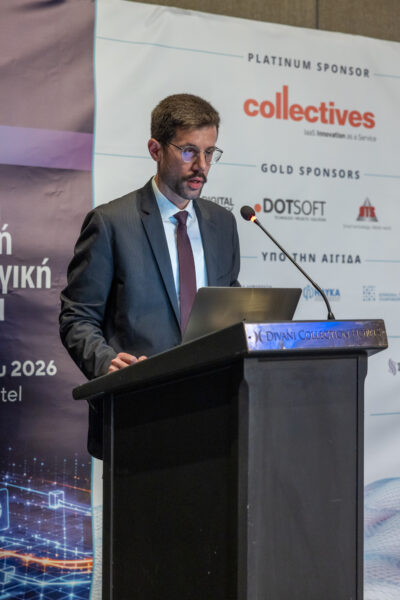
George Kanellos, Director of the Office of the Special Secretary for Artificial Intelligence and Data Governance, noted, among other things, that the development of advanced computing and AI infrastructure is a key priority of government policy for the country’s digital transformation.
He also referred to the national AI infrastructure initiatives being developed to strengthen digital sovereignty at both national and European levels, including the DAEDALUS supercomputer and the PHAROS AI Factory.
Sources: https://www.ictplus.gr/, https://ai-athens-summit.gr/