
The web portal Study in Greece is campaigning for the promotion and international visibility of Greek Universities and the comparative educational advantages of our country. In particular, the campaign focuses on the foreign language study programs that Greek Universities offer to Greek and international students. The initiative is supported by the General Secretariat of Higher Education of the Ministry of Education and Religious Affairs and the General Secretariat for Greeks Abroad and Public Diplomacy of the Ministry for Foreign Affairs. In this context, a number of educational programs and actions are presented in detail on a regular basis, such as undergraduate and postgraduate programs, summer schools etc, to inform international students about the many foreign language options offered by Greek Universities.

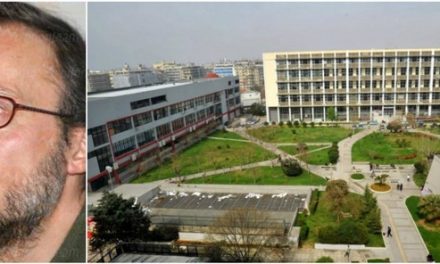
Manolis I. Stefanakis is Professor of Classical Archaeology and Numismatics in the Department of Mediterranean Studies at the University of the Aegean, where he also serves as Director of the BA in Eastern Mediterranean Studies (Archaeology–History–Culture). His research focuses on Classical Archaeology and Ancient Greek Numismatics, with particular emphasis on the interdisciplinary fields of Archaeology and Sustainability and Archaeoseismology.
Study in Greece interviewed Professor Manolis I. Stefanakis on the BA in Eastern Mediterranean Studies, its features and what it has to offer to international students.
Professor Stefanakis, please give us an overview of the brand new BA program in Eastern Mediterranean Studies, its structure and its main research areas.
The BA in Eastern Mediterranean Studies (Archaeology–History–Culture) is a four-year, interdisciplinary undergraduate program, fully taught in English and exclusively addressed to an international student body. The program focuses on the study of the Eastern Mediterranean from prehistoric times to the late Byzantine and medieval periods, combining approaches from archaeology, history, and classical and cultural studies. Its structure offers students a solid theoretical background alongside methodological training, encouraging comparative and cross-cultural perspectives. The main research areas include material culture, historical processes, cultural interaction, and the long-term dynamics that shaped societies across the Eastern Mediterranean world in the past.
How does your BA align with the general extroversion strategy and internationalization goals of the University of the Aegean?
The program is fully aligned with the internationalization strategy of the University of the Aegean. Being the first undergraduate program of the university taught entirely in English and exclusively addressed to international students, it significantly enhances the institution’s outward-looking orientation and global academic presence. By welcoming students from different countries and academic backgrounds, the BA in Eastern Mediterranean Studies promotes academic mobility, intercultural exchange, and international collaboration.
Could you give us more insights about the correlation between the subject of the program and the university’s key location?
The program’s subject matter is deeply connected to the geographical location of the Department of Mediterranean Studies: Archaeology, Linguistics, International Relations of the University of the Aegean, based on the island of Rhodes. Situated at a historical crossroads of the Eastern Mediterranean, Rhodes offers a unique living laboratory of archaeological sites and cultural landscapes spanning multiple historical periods. This strategic location allows students to directly engage with the material and historical realities they study.

What future prospects does your BA program open up for its graduates in the academic field and in the job market?
Graduates are well prepared for postgraduate studies and academic research in archaeology, history, heritage studies, and Mediterranean studies. Beyond academia, the program equips students for careers in museums, cultural institutions, heritage management, education, cultural tourism, international organizations, and the public and private sectors.
Your program is the first international undergraduate program featured in the University of the Aegean. Would you say that it is the first of many to be established in the university?
As the first, indeed, international undergraduate program of the University of the Aegean, this BA marks an important milestone. It reflects the institution’s commitment to expanding English-taught degrees and strengthening international outreach. While no official announcements have been made, I am sure that the program will serve as a model for future international initiatives.
What would you say to students that are interested in pursuing an academic path in this specific discipline to consider your program?
Students interested in the history, archaeology, and cultures of the Eastern Mediterranean will find this program an excellent foundation for an academic career. It offers a rigorous interdisciplinary curriculum within an international academic environment. The program prepares students to contribute meaningfully to scholarship, cultural heritage, and international dialogue, while offering an insight on living history on the island of Rhodes.
Applications are now open! For more, follow the link:

TAGS: ARCHAEOLOGY | CULTURE | HISTORY | STUDY IN GREECE