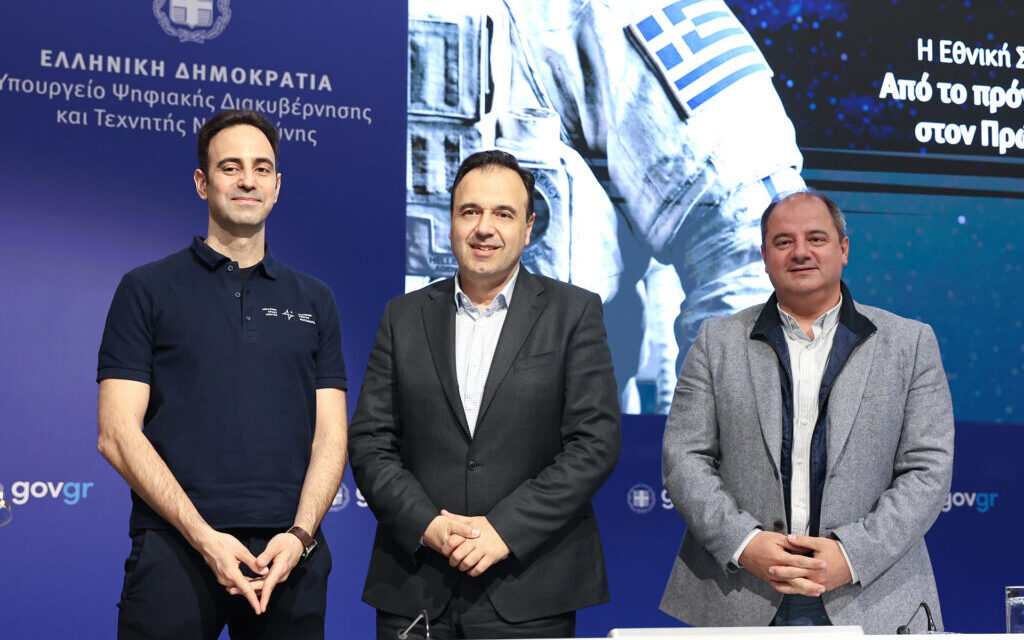
Minister of Digital Governance and Artificial Intelligence, Dimitris Papastergiou, presented the opportunities arising for Greece’s space ecosystem as Adrian Golemis becomes the first Greek to participate in the official European Space Agency (ESA) astronaut training program.
For the first time in its history, Greece is officially represented in an ESA astronaut training program. Adrian Golemis will soon begin his training at the European Astronaut Centre in Cologne, Germany. This development marks a major milestone in strengthening Greece’s presence in space research and technology, opening new opportunities for the country’s participation in international space missions. The training, scheduled to start in April 2026, is a fundamental prerequisite for future participation in space missions and includes an intensive program of theoretical instruction and practical exercises.
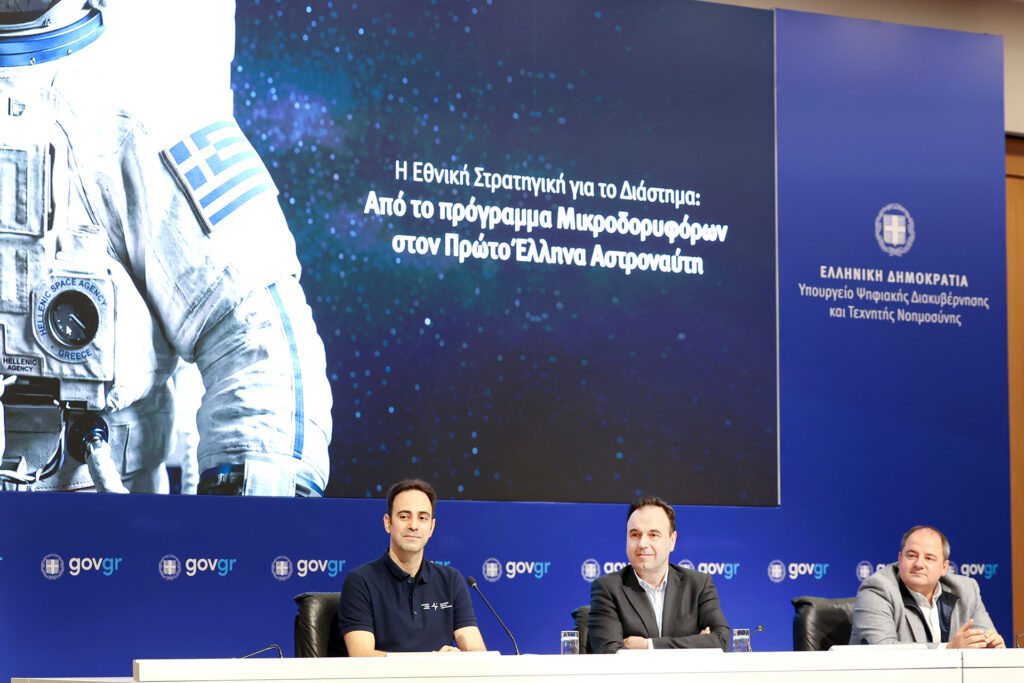
Minister Papastergiou stated: “The training of the first Greek astronaut is not only a personal achievement for Adrian; it is a powerful symbol of a new era for our country in space. It is living proof that Greece can design, participate, and play a leading role in a field that until recently seemed distant. I cannot think of a better proof than the fact that a Greek citizen will now have the opportunity to travel to space. Our national presence in space is not fragmented; it is part of a cohesive strategy that is already underway: from increasing our participation in ESA research programs to the National Microsatellite Program, whose first launches are already a reality. Six micro- and nanosatellites are currently in orbit, while in the coming days, weather permitting, six more Greek nanosatellites are expected to be launched. In April, we continue with thermal microsatellites, further expanding our operational capabilities in space. In this way, we are creating a comprehensive ecosystem of knowledge, innovation, and production”.
Adrian Golemis commented: “It is a great joy for me that, through the systematic work of the Hellenic Space Center and the General Secretariat of Telecommunications and Post, my success in ESA’s most recent astronaut selection has been transformed from a personal achievement into a national opportunity. It is an honor to help Greece be represented for the first time in the field of astronauts. Traveling to space has been a childhood dream. I am thrilled that we are moving forward with the right framework for our country: my integration into ESA’s astronaut training program expands the window for Greek companies, universities, and research institutions to participate in the agency’s collaborative programs, complementing the National Microsatellite Program that is already underway. Having worked in this field for eight years, I have witnessed the significant economic, scientific, geopolitical, and educational benefits that arise. I am particularly pleased that Greece is now moving in this direction and extending its activity in human and robotic space exploration. It is important to recognize that our country has a mature ecosystem capable of contributing to and benefiting from the European framework. Astronaut training also prepares us for the possibility of Greek participation, in collaboration with Europe and the U.S., in missions to the International Space Station (ISS), advancing domestic space research and technology for future applications that improve life on Earth. I would like to sincerely thank my family for their support, as well as every Greek citizen who has worked for our country’s entry into the astronaut program.”
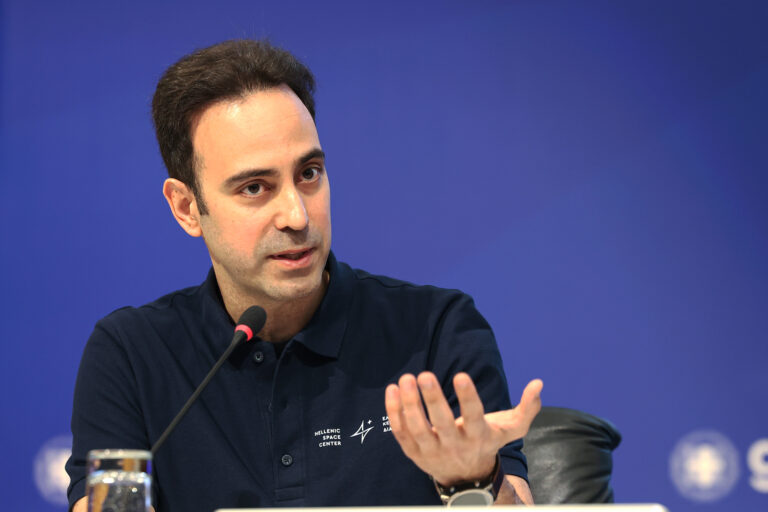
Brief Biography of Adrian Golemis
Adrian Golemis was born and raised in Larissa, studied medicine at Aristotle University of Thessaloniki, and completed an interdisciplinary Master’s in Space Sciences at the International Space University (ISU) in France.
He has lived and worked for one year in complete isolation with a small crew at the Concordia Station in Antarctica, conducting European experiments studying changes in human physiology and psychology under extreme living conditions similar to those in space. His next posting was at the French Institute of Space Medicine and Physiology (MEDES), where he worked on clinical studies simulating the challenges faced by the human body in space, aimed at improving understanding and care on Earth.
Since 2018, he has contributed to the medical support of ESA astronauts, currently serving as Lead Flight Surgeon. He is also a research collaborator at the Hellenic Space Center (ELKED).
In 2022, Golemis ranked first among 25 selected candidates out of 22,500 applicants in ESA’s astronaut selection process, becoming the first Greek citizen to complete all selection stages, enabling Greece to be represented in a research mission in space for the first time. Subsequently, he was elected a member of the International Academy of Astronautics (IAA).
Golemis also promotes science through public presentations and interviews, including many in schools.
Source: Ministry of Digital Governance and Artificial Intelligence